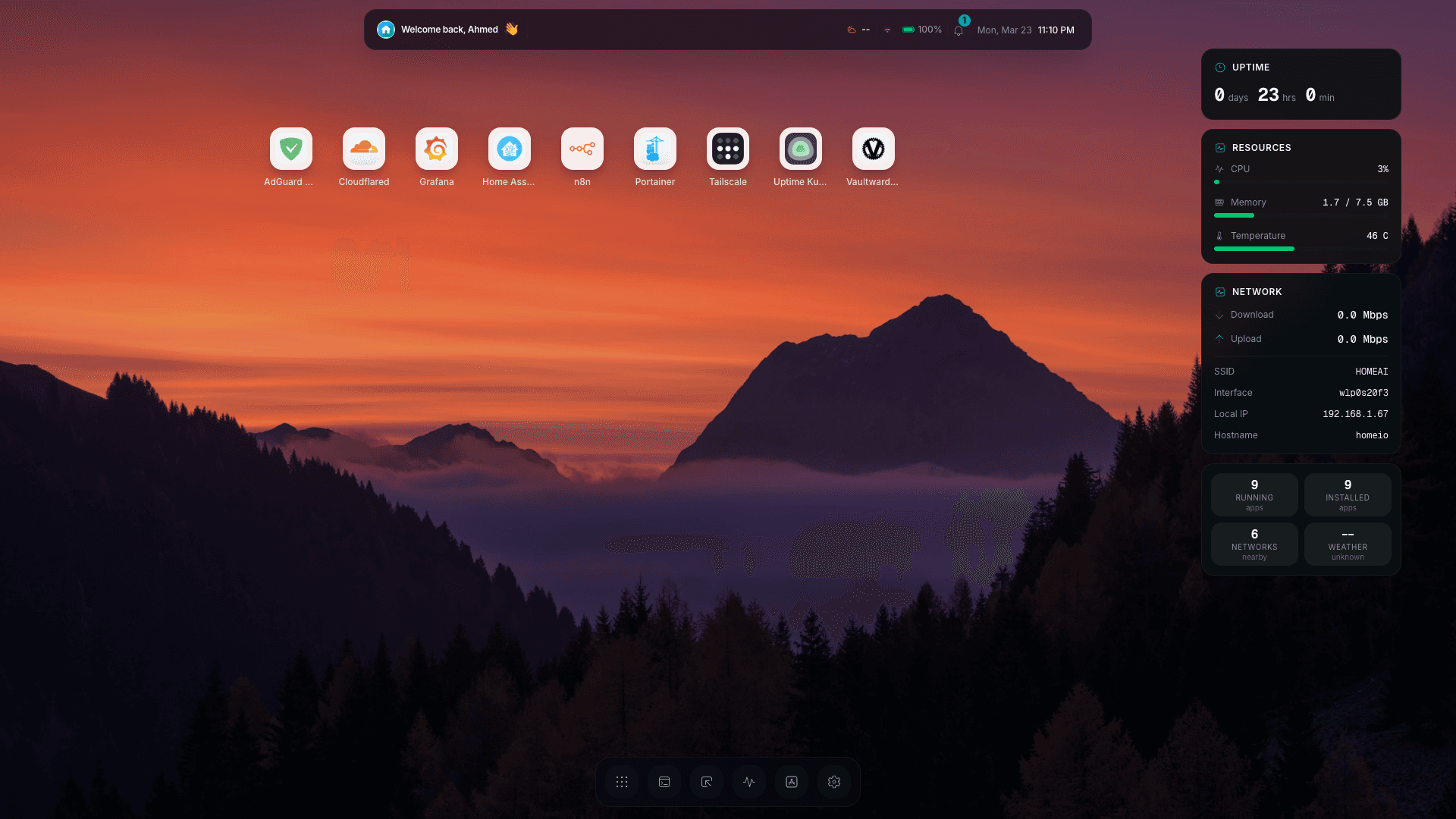
Building HomeIO: Making Self-Hosting Feel Like a Native Desktop
HomeIO started from a frustration I kept seeing in the self-hosted world: powerful tools existed everywhere, but the experience around them still felt fragmented. Installing Docker apps, jumping into a terminal, checking server health, and browsing files often meant switching between multiple dashboards with completely different UX. I wanted one product that made a personal server feel coherent, modern, and enjoyable to manage.
The Vision The concept was to bring the confidence and ergonomics of a native desktop operating system directly to the browser for home servers. HomeIO is designed as a glassmorphic workspace featuring a dock, floating window chrome, rich motion, and an intuitive hierarchy. The core goal: self-hosting should be visually polished without obscuring technical control.
Technical Architecture - Frontend & App Shell: Next.js 16, React 19, TypeScript, Tailwind CSS v4, and Motion. - Server Communication: Direct integration with Docker daemon via Unix sockets and REST endpoints to manage container lifecycles. - Embedded Terminal: Real-time WebSocket connection to a PTY session for instant shell access. - One-Line Deployment: Lightweight installer script served via `get.homeio.app` enabling zero-dependency deployment on Linux/Debian hosts.
Key Functional Modules 1. Curated App Store: One-click deployments for popular self-hosted applications (Nextcloud, Plex, Vaultwarden, AdGuard Home). 2. Interactive File Manager: Local and network-mounted storage navigation with drag-and-drop file uploads. 3. Hardware Telemetry: Real-time CPU, RAM, disk I/O, and temperature monitoring using streaming event updates. 4. Windowing Engine: Multi-tasking desktop window manager supporting minimization, snapping, and z-index ordering.
Open Source & Future HomeIO is open-source and continuously evolving. The focus remains on lowering the operational barrier to personal data ownership while preserving transparency and speed.
Related Posts

Building LIVE Solution: Real-Time Passenger Information for 5M+ Travelers
Serving as React Technical Referent in a 42-developer SAFe organization at SNCF Connect. Real-time passenger display, AWS Serverless stack, and 90%+ TDD/BDD coverage.

Scaling Orange's Customer Platform: Cloud-Native Microservices & Angular 10
Frontend architecture ownership on Angular 10 for Orange's national platform, managing billing, usage tracking, and customer support for millions of subscribers.